Yes evidently - this video takes the banning of Richard Dawkins for hate speech against Islam and asks the question - can you use hate speech against an IDEA?
THE UNQUESTIONABLE IDEA

Neoliberals advocate de-regulation in economic life while postmodernists advocate de-regulation in the cultural sphere. The new relativism of postmodernism matches with the laissez-faire attitude of neoliberals. Both currents of thought place the isolated individual in the centre of attention. Everybody has his/her own culture. The ‘I’ is liberated from the ‘we’. Both deny the possibility of steering or planning social developments, but proclaim the ability of individuals to re-create themselves. LinkSo now, the rules are different - young people have 'rights'. The right -
A normal pregnancy lasts about 40 weeks. A human device would be designed for those born 23 or 24 weeks into pregnancy.
Only about half of such babies survive and, of those that do, about 90 percent suffer severe complications, such as cerebral palsy, mental retardation, seizures, paralysis, blindness and deafness, Flake says.
About 30,000 babies are born earlier than 26 weeks into pregnancy each year in the United States, according to the researchers.But, it's not that simple.
Davis worries that the device is not necessarily a good solution for human fetuses.
"If it's a difference between a baby dying rather peacefully and a baby dying under conditions of great stress and discomfort then, no, I don't think it's better," Davis says.
"If it's a question of a baby dying versus a baby being born who then needs to live its entire life in an institution, then I don't think that's better. Some parents might think that's better, but many would not," she says.
And even if it works, Davis also worries about whether this could blur the line between a fetus and a baby.
"Up to now, we've been either born or not born. This would be halfway born, or something like that. Think about that in terms of our abortion politics," she says.And, it could get worse!
There's also a danger such devices might be used coercively. States could theoretically require women getting abortions to put their fetuses into artificial wombs, says Scott Gelfand, a bioethicist at Oklahoma State University.
Employers could also require female employees to use artificial wombs to avoid maternity leave, he says. Insurers could require use of the device to avoid costly complicated pregnancies and deliveries.
"The ethical implications are just so far-reaching," Gelfand says.In the UK, we have torn each other apart with the Charlie Gard case. Charlie Gard would not have been helped by gestating full term in an artificial womb, but he would be condemned to just 'being' rather than living.
THE CORPSE PROJECT
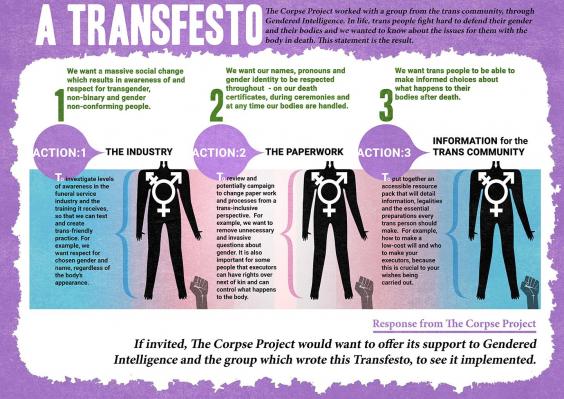
Today researchers and activists in London released a ‘transfesto’, calling for greater awareness of issues faced by transgender, non-binary and gender nonconforming people after they die.The manifesto calls on the funeral industry to develop more trans-friendly practices and for official death-related paperwork to be more trans-inclusive. It also outlines plans to make trans-specific legal information more easily accessible. >>>“Trans people must constantly self-advocate in life — for those of us with the privilege to plan for our futures instead of just our immediate survival, there is always a worry for us that our corpses will not be respected in death,” says Morgan Potts, a member of the Dysphoria Collective, who participated in the research. Concerns include ensuring that their chosen gender, pronoun and name is used both on official documents and in memorial ceremonies regardless of the body’s appearance.

Neoliberalism – the ideology at the root of all our problems
So pervasive has neoliberalism become that we seldom even recognise it as an ideology. We appear to accept the proposition that this utopian, millenarian faith describes a neutral force; a kind of biological law, like Darwin’s theory of evolution. But the philosophy arose as a conscious attempt to reshape human life and shift the locus of power.
Neoliberalism sees competition as the defining characteristic of human relations. It redefines citizens as consumers, whose democratic choices are best exercised by buying and selling, a process that rewards merit and punishes inefficiency. It maintains that “the market” delivers benefits that could never be achieved by planning.
>>>>
Among the results, as Paul Verhaeghe documents in his book What About Me? are epidemics of self-harm, eating disorders, depression, loneliness, performance anxiety and social phobia. Perhaps it’s unsurprising that Britain, in which neoliberal ideology has been most rigorously applied, is the loneliness capital of Europe. We are all neoliberals now.
Do read the whole article - it's illuminating!It’s the missing chapter: a key to understanding the politics of the past half century. To read Nancy MacLean’s new book Democracy in Chains: the deep history of the radical right’s stealth plan for America is to see what was previously invisible.
The history professor’s work on the subject began by accident. In 2013 she stumbled across a deserted clapboard house on the campus of George Mason University in Virginia. It was stuffed with the unsorted archives of a man who had died that year, whose name is probably unfamiliar to you: James McGill Buchanan. She writes that the first thing she picked up was a stack of confidential letters concerning millions of dollars transferred to the university by the billionaire Charles Koch.Her discoveries in that house of horrors reveal how Buchanan, in collaboration with business tycoons and the institutes they founded, developed a hidden programme for suppressing democracy on behalf of the very rich. The programme is now reshaping politics, and not just in the US.Buchanan was strongly influenced by both the neoliberalism of Friedrich Hayek and Ludwig von Mises and the property supremacism of John C Calhoun, who argued, in the first half of the 19th century, that freedom consists of the absolute right to use your property – including your slaves – however you may wish. Any institution that impinges on this right is an agent of oppression, exploiting men of property on behalf of the undeserving masses.James Buchanan brought these influences together to create what he called “public choice theory”. He argued that a society could not be considered free unless every citizen has the right to veto its decisions. What he meant by this was that no one should be taxed against their will. But the rich were being exploited by people who use their votes to demand money that others have earned, through involuntary taxes to support public spending and welfare. Allowing workers to form trade unions and imposing graduated income taxes are forms of “differential or discriminatory legislation” against the owners of capital.Any clash between what he called “freedom” (allowing the rich to do as they wished) and democracy should be resolved in favour of freedom. In his book The Limits of Liberty, he noted that “despotism may be the only organisational alternative to the political structure that we observe.” Despotism in defence of freedom.
