There is something strange afoot on this planet. And we are getting caught in the currents of a new insanity. It's new, because, in the course of history, there has never been any question about some established facts of nature.
Baby things are usually either male or female. When they mature, they make further male or female babies. It's called reproduction. Sometimes, as in certain fishes, and snails males can change to female or self fertilise. Like plants. That doesn't work in complex animals.
Male and female animals are stuck with what their chromosomes gave them.'Feelings' didn't used to change their sex.
How alien can this place be? There is no observable reality anymore. You can be anything you want to be by 'feeling' it and legally too. And others must conform with your perception of you.
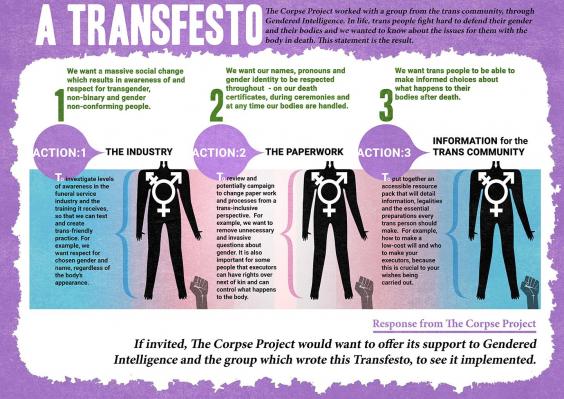
Today researchers and activists in London released a ‘transfesto’, calling for greater awareness of issues faced by transgender, non-binary and gender nonconforming people after they die.The manifesto calls on the funeral industry to develop more trans-friendly practices and for official death-related paperwork to be more trans-inclusive. It also outlines plans to make trans-specific legal information more easily accessible. >>>“Trans people must constantly self-advocate in life — for those of us with the privilege to plan for our futures instead of just our immediate survival, there is always a worry for us that our corpses will not be respected in death,” says Morgan Potts, a member of the Dysphoria Collective, who participated in the research. Concerns include ensuring that their chosen gender, pronoun and name is used both on official documents and in memorial ceremonies regardless of the body’s appearance.
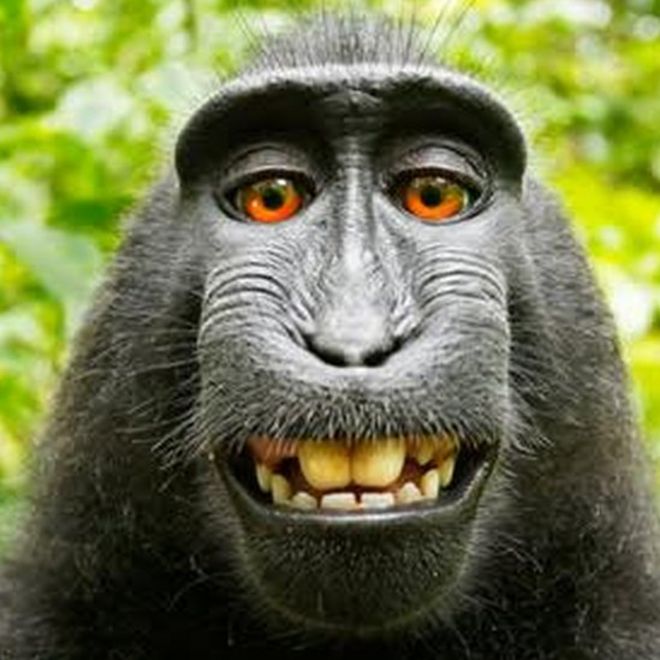
Not only do such concerns about death feel strange on the planet I inherited/remembered, but animals have become so clever they can sue you! Taking a selfie is pretty cute - but suing you for the copyright to it, is mind-bogglingly intelligent. What HAS happenned to animals? Do you think threy are just 'feeling' like humans?
I think everyone has a sort of bullshit periscope in their brains. When bullshit enters their ears, the periscope looks about to see where it's coming from.
My bullshit periscope oscillates all the time trying to fathom out what is wrong with the planet as I find it now. There is something seriously wrong with society. It's insane. It's daft.
I cannot put my finger on it.
My bullshit periscope reads a lot. It watches videos. It computes, weighs up, sums up and descerns. At night it drops down into its storage department in my head, refreshing for the next day.
Everyone has such descernment. It's not just me that thinks society has gone to hell in a handcart. On this blog, I'm going to complain. But I want to complain intelligently. 'Neoliberalism' is a new word for me..
Here is George Monbiot, whose writing I enjoy - but not always agree with, on Neoliberalism in an article from the Guardian last year -
So pervasive has neoliberalism become that we seldom even recognise it as an ideology. We appear to accept the proposition that this utopian, millenarian faith describes a neutral force; a kind of biological law, like Darwin’s theory of evolution. But the philosophy arose as a conscious attempt to reshape human life and shift the locus of power. Neoliberalism sees competition as the defining characteristic of human relations. It redefines citizens as consumers, whose democratic choices are best exercised by buying and selling, a process that rewards merit and punishes inefficiency. It maintains that “the market” delivers benefits that could never be achieved by planning.
>>>>
Among the results, as Paul Verhaeghe documents in his book What About Me? are epidemics of self-harm, eating disorders, depression, loneliness, performance anxiety and social phobia. Perhaps it’s unsurprising that Britain, in which neoliberal ideology has been most rigorously applied, is the loneliness capital of Europe. We are all neoliberals now.
This whole article is well worth reading - do it first - because TODAY he has published another interesting article called The Missing Link which dovetails nicely.
The history professor’s work on the subject began by accident. In 2013 she stumbled across a deserted clapboard house on the campus of George Mason University in Virginia. It was stuffed with the unsorted archives of a man who had died that year, whose name is probably unfamiliar to you: James McGill Buchanan. She writes that the first thing she picked up was a stack of confidential letters concerning millions of dollars transferred to the university by the billionaire Charles Koch.
Her discoveries in that house of horrors reveal how Buchanan, in collaboration with business tycoons and the institutes they founded, developed a hidden programme for suppressing democracy on behalf of the very rich. The programme is now reshaping politics, and not just in the US.
Buchanan was strongly influenced by both the neoliberalism of Friedrich Hayek and Ludwig von Mises and the property supremacism of John C Calhoun, who argued, in the first half of the 19th century, that freedom consists of the absolute right to use your property – including your slaves – however you may wish. Any institution that impinges on this right is an agent of oppression, exploiting men of property on behalf of the undeserving masses.
James Buchanan brought these influences together to create what he called “public choice theory”. He argued that a society could not be considered free unless every citizen has the right to veto its decisions. What he meant by this was that no one should be taxed against their will. But the rich were being exploited by people who use their votes to demand money that others have earned, through involuntary taxes to support public spending and welfare. Allowing workers to form trade unions and imposing graduated income taxes are forms of “differential or discriminatory legislation” against the owners of capital.
Any clash between what he called “freedom” (allowing the rich to do as they wished) and democracy should be resolved in favour of freedom. In his book The Limits of Liberty, he noted that “despotism may be the only organisational alternative to the political structure that we observe.” Despotism in defence of freedom.
He smokes? Or smoked? That makes me immediately warm to him. He's MY age. He says things I can understand, and that feel right and wise to me.
He's a Conservative. Very.
I don't know what I am. I'm 72. I don't like this strange planet I find myself on. It is so changed that I don't feel at home on it anymore. Maybe I'm a Conservative?
I listened to this video. I'm archiving it here. I might want to watch it again to retrieve the thoughts I had today. It made me feel that my Alien Planet, might, in good time, become HOME again.
For years I posted on this blog. It's called 'Life on an Alien Planet'. I called it that, because the older I get, the more alien to me this planet gets!
But several years ago, I stopped writing here because life seemed rather busy and I have other blogs - but the main reason was that constantly complaining which I did here, is a sort of negative thing.
However,
the world is getting weirder and weirder and I'm getting older and older, so I'm taking my complaining ways back!
I'm resurrecting this Blog.
I see people still read it after years of it being inactive - that's a surprise! Thank you people.
From now on, I'm posting all the wonderful stuff I find on the Internet - usually other people complaining.
I enjoy complaining if it's about big things that should CHANGE - or stuff we all should know about. That way, you forget to complain about the small stuff that isn't really important.
This will be my complaints archive. A small token in trying to make this planet seem less alien and more like HOME.
I am discontinuing writing this blog - "Life on an Alien Planet" - because I need time to devote to it. I do not have the time. So it hangs on my shoulders like a cloak of guilt - another something I have not done AGAIN today!
I hate that feeling.
I am going to be free!
Thank you for following me and reading my ramblings. I'm just called Vapingpoint, or Vapingpoint Liz. I shall be on Vapingpoint as usual. And I'm on Twitter, Facebook, You Tube and Google+
My wish for 2014 was that things we know, will gradually be accepted in the Mainstream, as things we know!
Much knowledge has been trashed by "experts" as being pseudoscience, or myth. I remember reading an article on The Gaps Diet by a "scientist" saying it was all a load of **** - well not in such words, but it was dismissed out of hand as rubbish.
The Gaps Diet is about re-populating the gut with missing microbes. And in the beginning, it's quite difficult to do. But it is primarily for people who cannot get rid of serious conditions.
But the Full Gaps Diet is not dissimilar to the Paleolithic diet, (general Google collection) which, I know, from personal experience sorts out all sorts of health problems people have. And people practising most forms of alternative medicine, have been on about anti biotics and gut flora for many many years.
Gradually, it has dripped, dripped, dripped into the medical mind that maybe there is something in having or not having the correct gut flora after all.
It's a pity science phoo phoo's first, and takes so long to "prove" what to others, is so blatantly the truth.
Recently, I have noticed several, if not many, articles in Mainstream Media about the importance of gut flora.
I am posting the whole article from The New York Times yesterday here, before it disappears behind a pay-wall....it's reviewing a new book, and is somewhat thought provoking.
"You never get something for nothing, especially not in health care. Every test, every incision, every little pill brings benefits and risks.
Nowhere is that balance tilting more ominously in the wrong direction than in the once halcyon realm of infectious diseases, that big success story of the 20th century. We have had antibiotics since the mid-1940s — just about as long as we have had the atomic bomb, as Dr. Martin J. Blaser points out — and our big mistake was failing long ago to appreciate the parallels between the two.
Antibiotics have cowed many of our old bacterial enemies into submission: We aimed to blast them off the planet, and we dosed accordingly. Now we are beginning to reap the consequences. It turns out that not all germs are bad — and even some bad germs are not all bad. In “Missing Microbes,” Dr. Blaser, a professor of medicine and infectious diseases at New York University, presents the daunting array of reasons we have to rethink the enthusiastic destruction of years past.
First and foremost, the war has escalated. Imprudent antibiotic use has resulted in widespread resistance among microbes; infectious disease doctors (I am one, as well as a casual acquaintance of Dr. Blaser’s) now operate in a state of permanent near panic as common infections demand increasingly powerful drugs for control.
Second, as always, it is the hapless bystanders who have suffered the most — not human beings, mind you, but the gazillions of benevolent, hardworking bacteria colonizing our skin and the inner linings of our gastrointestinal tracts. We need these good little creatures to survive, but even a short course of antibiotics can destroy their universe, with incalculable casualties and a devastated landscape. Sometimes neither the citizenry nor the habitat ever recovers.
And finally, there is the accumulation of disheartening evidence that the war against the old plagues is simply leading to worse wars against a whole series of new ones.
Parts of Dr. Blaser’s argument are familiar, such as the story of Clostridium difficile colitis, an increasingly common cause of diarrhea. This condition arises most often when a course of antibiotics skews the normal microbial population of the gut to favor a single toxin-producing organism. Sometimes yet more antibiotics will restore normal intestinal function. But sometimes no treatment works — nothing but infusing feces full of normal bacteria into the ailing intestines, a last-ditch strategy that has proved stunningly successful. Without it, otherwise perfectly healthy people can die.
Less familiar is the paradox posed by the little comma-shaped organism Helicobacter pylori, a denizen of the human stomach. Dr. Blaser is one of the world’s experts in these “ulcer bacteria,” which are associated not just with ulcers but also with stomach cancer. We have been slowly eradicating H. pylori with antibiotics — the organisms have become quite uncommon in developed countries.
But as they vanish, Dr. Blaser notes, a small epidemic of esophageal disease follows, with inflammation causing heartburn and even cancer. It turns out that this bad germ is also good, instrumental in protecting the human esophagus from trouble.
And that’s not all, folks, far from it.
We know that giving antibiotics to young chickens, cows and pigs means bigger, fatter animals brought to market. But we are doing pretty much the same thing to our own young, repeatedly dosing them up against all the infections of childhood (many of which do not require antibiotics to resolve). The results of an interconnected series of experiments in Dr. Blaser’s lab, with infant mice fed a variety of antibiotic regimens, lend strong support to the theory that exposure to antibiotics early in life has long-term effects on metabolism, and may contribute to our epidemic of childhood and adult obesity.
For other increasingly common conditions such as asthma, inflammatory bowel syndrome and celiac disease, Dr. Blaser offers an inversion of the so-called hygiene hypothesis, which holds that by removing us from contact with outdoor microbes, sanitized modern life has allowed the immune system to spiral out of control. Instead, he suggests, blame rests on the distortion of our internal microbial world.
Antibiotics are partly responsible, but so are other medical habits, such as our increasing use of cesarean sections. These aseptic procedures prevent newborns from acquiring their mothers’ organisms through the birth canal, possibly setting them up for a lifetime of trouble, with higher than normal risks of a range of immune-related problems.
Dr. Blaser presents this all at a rapid clip, not stinting on the technical language but infusing enough human interest to make his argument and data reasonably accessible. (He had writing help from Sandra Blakeslee, a veteran science journalist and a frequent contributor to Science Times.)
The discerning reader should not forget that the research he discusses is largely his own; we hear no dissenting voices or contradictory evidence, although much of the narrative remains scientifically hypothetical.
That said, however, the weight of evidence behind Dr. Blaser’s cautions about antibiotics is overwhelming. They are certainly lifesaving drugs — they saved his own life when he had typhoid fever, and he testified in Congress recently on the urgent need to develop better and stronger ones. But they are also immensely dangerous, both to individuals and to the firmly linked communities of microbes and men." end quote